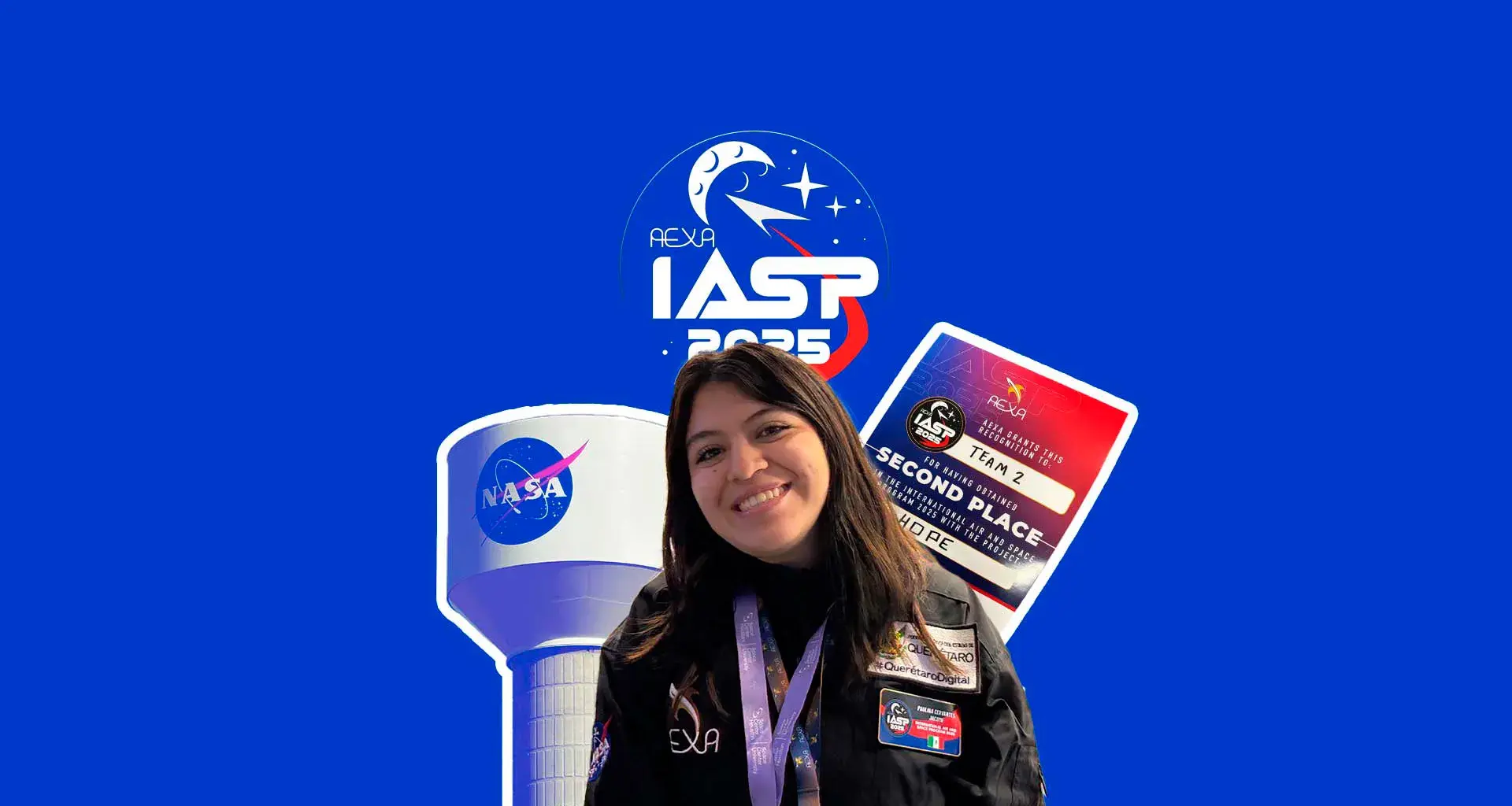

The female student from the Tec’s Querétaro campus made it to second place in the competition held in Houston, Texas.
For helping her team design a smart suit to tackle medical emergencies in space, Mechanical Engineering student Paulina Cervantes Jácome from Tec de Monterrey obtained second place in the International Air and Space Program (IASP), an initiative developed in collaboration with AEXA and NASA.
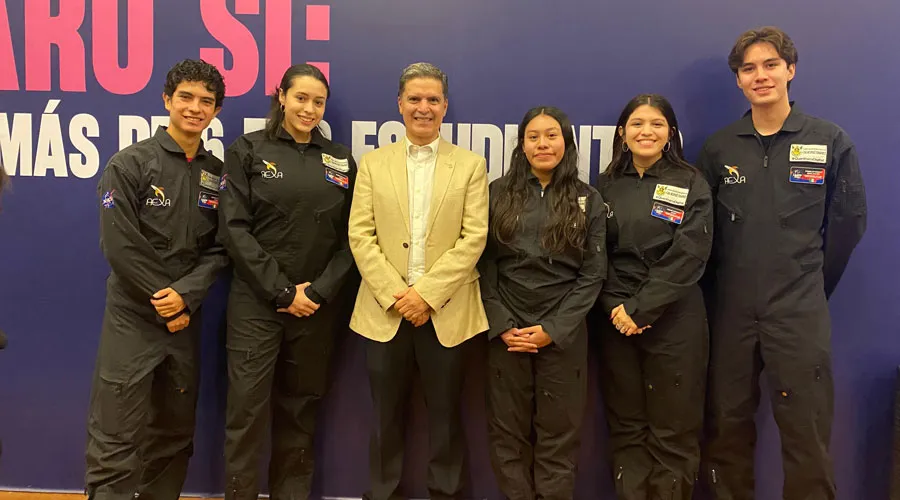
The student was on the State of Querétaro delegation that took part in the international program’s third edition, where she presented the Hope project developed in collaboration with four other students.
Their proposal seeks to reduce the impact of delayed space communications through the use of artificial intelligence and holographic technology, thereby improving the response to critical medical situations during off-Earth missions.
“We developed a smart suit with haptic sensors capable of assisting during medical emergencies in space”, explained Paulina.

From challenge to solution
During their stay, the program challenge consisted of optimizing communications between space and Earth, bearing in mind that there could be delays of up to 40 minutes in transmitting information. The goal was to streamline these processes without jeopardizing the mission or the astronaut’s safety.
Based on this scenario, the team decided to narrow the problem down to focus on one crucial aspect of missions: astronauts’ physical and mental health.
“We had a lot of ideas and couldn’t make up our minds; we wanted to tackle so many aspects”, said the student.
That’s how “Hope” was born, a smart suit consisting of two-way haptic sensors connected to holographic visors that enables the simulation of human contact and the provision of remote medical treatment. This technology also seeks to reduce the effects of prolonged isolation in space.
In addition to this suit’s applications for space missions, the team also sees it being implemented on Earth in areas such as physiotherapy, medicine, or even sports.
The event was held from November 10 to 14, 2025, gathering 65 participants from different countries such as Ecuador, El Salvador, Mexico, and even Madagascar to immerse them in different activities focused on the aerospace sector.
These included the student having the opportunity to fly a small plane at 8,000 feet, practice indoor parachuting, and experience a simulation of zero gravity under water.
“I got the chance to learn more about how mission control works and the different roles involved beyond the astronauts”, she explained.
Her journey to the program
To compete in the IASP, Cervantes had to meet several requirements, including having a valid visa, mastery of English, and passing the AEXA interview, which assessed her knowledge of NASA’s history, space projects, and current initiatives.
In parallel with this process, she also took part in a state program called “Contigo, Querétaro Digital te Lleva al Espacio” (Digital Querétaro Takes You into Space), which awarded her a government grant. This involved her writing an essay on the colonization of the moon and Mars and how this effort could serve as a model for fostering internationalization on Earth.
“It was a really interesting experience. We went to Nassau Bay, where the NASA astronauts and employees live, while the NASA facilities were just across the street”, she remarked.
Paulina was chosen along with 34 other participants to receive several kits from SEJUVE (Querétaro’s Secretariat of Youth), which were useful during their trip to Houston.
"We developed a smart suit with motion and pressure sensors that was capable of tackling medical emergencies in space"
Creating, trying, and achieving
The student highlights that the Tec provided her with the tool of adaptability, which was crucial. She mentions that one of her biggest complaints about the program was a shortage of time to work. However, thanks to the TEC21 model, she was able to perform well in high-pressure situations, managing to find practical solutions quickly.
“College has enabled me to develop skills such as teamwork, camaraderie, and leadership; it prepared me to speak in public, a skill which made it easier to for me to give the final presentation”, she added.
Finally, Paulina urged readers to get out of their comfort zones to follow their dreams, regardless of how impossible they may seem. “I did a lot of things for the first time. One thing I’ve discovered is how to let go of my fears and learn as much as I can from situations”, she emphasized.
She reminded them that learning goes beyond classrooms and encouraged them to put their fears behind them and take a gamble on attempting whatever they are passionate about.
“For me, entering the IASP was something very different. However, winning second place this year was really impressive”, she concluded.
YOU’LL SURELY WANT TO READ:
Notas Relacionadas
Seleccionar notas relacionadas automáticamente
0
Category:
Related stories