
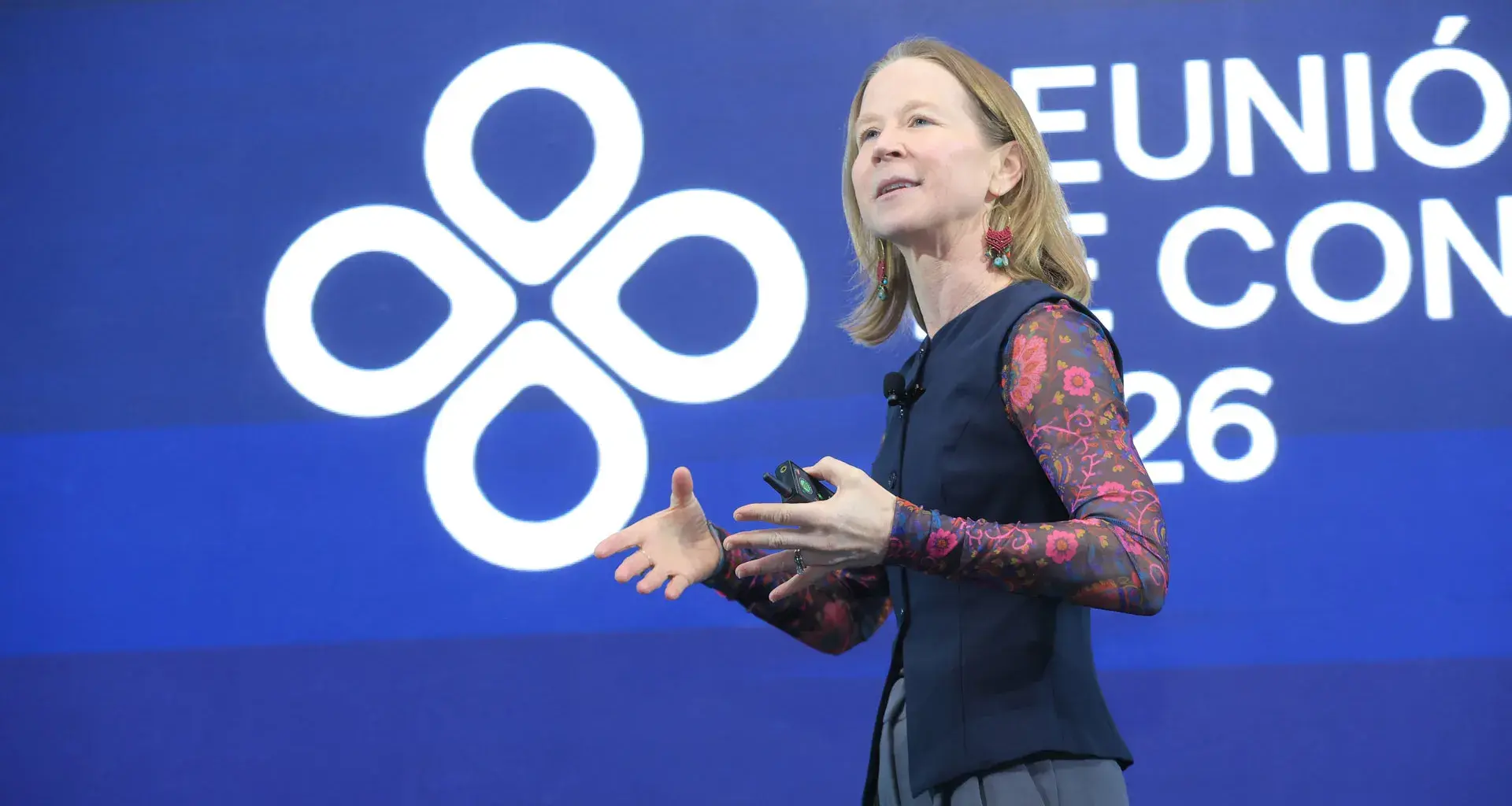

Futurist April Rinne shared the “superpowers” for thriving in constant change
The morning session began with a metaphor about ships and storms. April Rinne stood before the board of trustees of Tecnologico de Monterrey Education Group, describing them as a flotilla trying to navigate past rocky shores while a dangerous wind pushed them toward destruction.
"My role today is not to promise you calm seas," she told the council, "but to help make all of you better sailors."
By afternoon, that same message would reach Campus Santa Fe’s students who gathered to hear from the global futurist who has spent 25 years studying uncertainty.
For both audiences, Rinne's core thesis remained consistent: More change is coming. The instability isn't temporary. And the sooner everyone, from trustees to students, accepts that, the better equipped they'll be to thrive.

It's a message she's been refining for decades, but one that crystallized personally at age 20, when a phone call shattered her assumptions about the future. Both of her parents had died in a car crash.
"That was my flux," she told the students that afternoon. The support system she'd relied on disappeared. The career path she'd envisioned became irrelevant.
She had to figure out not just how to survive, but how to build a life worth living when nothing felt certain.
That experience became the foundation for what she now calls the flux mindset: seeing constant change not as an obstacle to overcome, but as the very condition in which we must learn to flourish. It's also the core of her bestselling book Flux: 8 Superpowers for Thriving in Constant Change.
The Breaking Ladder
In her morning session with the board, Rinne was blunt about the career ladder's limitations. The industrial-era concept of climbing steadily upward doesn't align well with a world where AI is automating entry-level positions and entire industries can be disrupted in years.
"Career ladders are a result of the first Industrial Revolution, which started more than 250 years ago," she told the trustees. "We're in the fourth Industrial Revolution now. Maybe the fifth. And yet we have not updated how we see and design our careers."
She pointed to "junior extinction," the term used to explain how AI is obliterating the first rungs of the career ladder. But technology wasn't the only force breaking the system. Students themselves don't want to be on someone else's ladder anymore.
In an interview with Conecta, Rinne explained how this new strategy was an opportunity to showcase skills, experiences, and perspectives that extended far beyond a typical resume.
“We’re finding lots of different ways to create meaningful, successful careers that aren’t on the ladder,” she said. As she thinks about the future of work, that ladder is not “future-ready.” It’s also less and more accessible and available to those entering the workforce.
"Every single one of you right now, you already have a portfolio," she told the students. Whether they've held paid jobs or not, they possess a unique combination of skills and experiences beyond just their credentials that make them valuable.
This resonated in the context of artificial intelligence. Students worry about automation eliminating the jobs they're training for.
Rinne's response was both pragmatic and hopeful. The skills that make up your portfolio like empathy, trust, and creativity can't be automated.
"Those aren't something AI can ever take away. Your portfolio is yours forever. No one can fire you from it," she told the crowd of students.

The Paradox of Letting Go
One superpower outlined in Rinne’s book sounds particularly counterintuitive to ambitious young people: let go of the future. But Rinne pushed back on the assumption that she was talking about abandoning goals.
"There is no one future," she explained to both audiences. "All we have is the present." What exists instead are multiple possible futures, and everyone is responsible for helping bring those possibilities into being.
“We need to let go of the things that aren’t fit for the future in order to create space and energy for what is actually our life,” she told CONECTA.
Her challenge to the trustees: What do you need to let go of to give Tec's future the best possible chance? To students: What assumptions about your future are holding you back?
Another superpower seemed equally counterintuitive: “run slower.” Rinne acknowledged telling 20-year-olds to slow down was a hard sell. They have energy. They can pull all-nighters.
But, she explained, when you're constantly running fast, your brain treats every change as a tiger chasing you. You lose the ability to filter for what's important and the ability to see the bigger picture.
She asked the students how many felt like they were running all the time. Almost every hand in the audience went up. How many would prefer not to? The same hands stayed raised.
The antidote was simple: intentional time offline, moments of doing nothing, space for daydreaming.
She pointed to successful people, not just in achievement, but happy with the lives they've designed. "Not a single one of them will wish that they had just pushed harder and kept going. It's about balance."
Trust as foundation
When a student asked how to know if you're adapting well or overdoing it to the point of burnout, Rinne circled back to what she considers the most important superpower: trust.
Her advice was to trust yourself that you can figure things out, trust others so you don't have to navigate change alone and build trustworthy relationships that will sustain you.
"Your ability to trust yourself, to trust other people, and to have trusted relationships will get you farther in life than any class you take or any credential you get," she said.
This became especially clear when a student asked about applying the flux mindset amid serious societal challenges: hunger, violence, and other crises in Mexico. How do you maintain this when facing genuine threats?
Rinne was honest. A flux mindset won't solve all the world's problems. No individual can fix structural inequality alone.
But don't try to figure it out in isolation. "Nothing will help you navigate change better than trust in human relationships," she told students.
Drawing on her work in over 100 countries, Rinne offered a different lens on uncertainty rooted in Tibetan Buddhism. In Western cultures, not knowing the answer is seen as failure. But in Tibetan culture, there's a concept called the bardo which is the place of not knowing.
In the West, the bardo is something to escape. In Tibetan Buddhism, it's the most sacred place to be, because it's where transformation happens.
"What if you had grown up in a culture where not having the answer was celebrated?" she asked the students.
A Day of Transformation
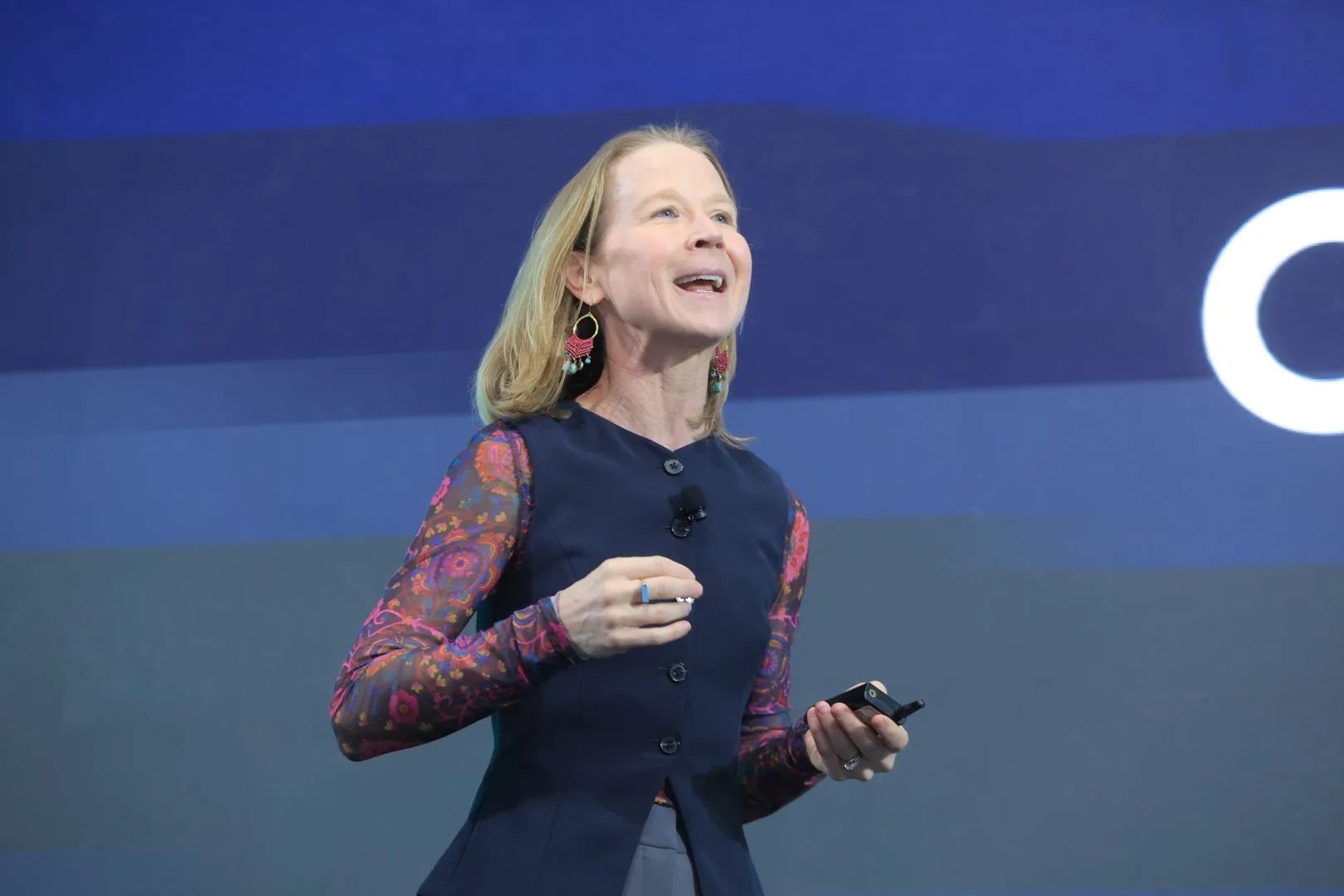
Rinne had opened the day acknowledging that 70% of traditional change management initiatives fail, largely because they eliminate the human experience of change. What she offered instead wasn't a process or checklist, but a fundamental reframing.
"Mindset shapes strategy, not the other way around," she told the governance council.
In her interview later, reflecting on whether we've collectively improved at dealing with uncertainty since the pandemic, she was measured.
"We certainly have become much more aware of it. There's an openness to talking about it, an acknowledgement that it isn't going away," she said.
But awareness alone isn't enough. Getting better at navigating uncertainty takes work, she explained. That work looks like daily practice, intentional choices, and a willingness to challenge assumptions that once felt certain.
"Uncertainty is opportunity in its purest form," she'd told the board that morning.
By day's end, surrounded by students eager to share their own struggles with change, that statement felt less like optimism and more like a practical necessity for anyone hoping to thrive in the years ahead.
About the Speaker
April Rinne is an American futurist, international keynote speaker, bestselling author, and expert in reshaping our relationship with uncertainty and constant change.
Recognized by Forbes as one of the 50 leading female futurists, she helps organizations navigate disruption.
She is the author of Flux: 8 Superpowers for Thriving in Constant Change.
Advisors Meeting 2026
From February 16–17, the 2026 Advisors Meeting, titled “The Course in Action,” took place in Mexico City, highlighting progress on the Educational Group’s 2030 Strategic Plan, first introduced at the previous edition.
The meeting was held as part of the Tec’s 50th anniversary in Mexico City and, for the first time, took place in the capital.
Prior to this event, on February 13, the Annual Ordinary Assembly of Associates was held in Monterrey, where the 2025 results and progress were reviewed.
“Your commitment and dedication are a source of inspiration and a cornerstone for continuing to build a bright future,” said Ricardo Saldívar, Chairman of the Board of the Tecnológico de Monterrey Educational Group.
READ ALSO:
Seleccionar notas relacionadas automáticamente
1
Category:
Related stories