
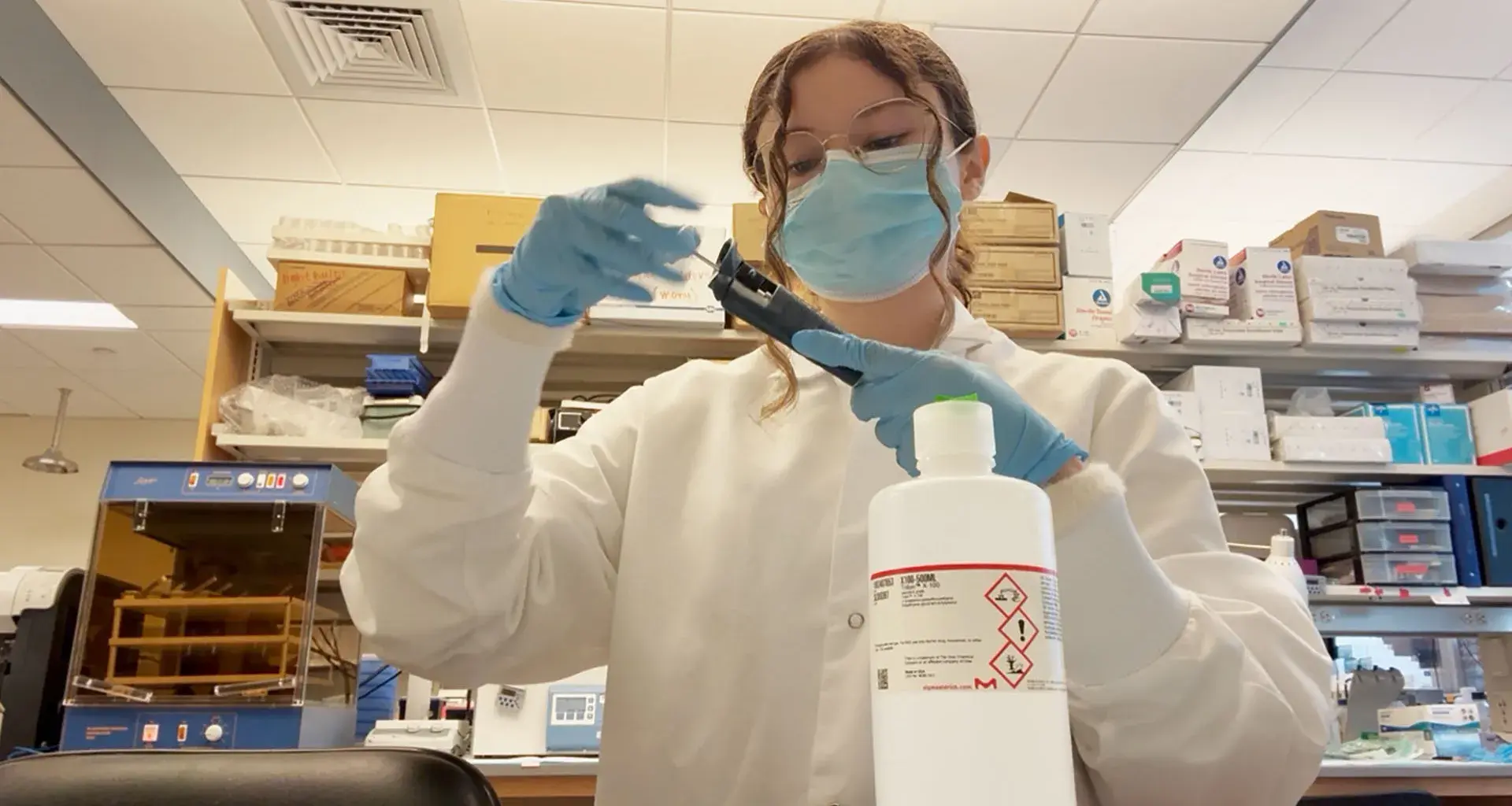

Recent Monterrey campus graduate Alexandria Aguirre has completed over 2,000 hours of a professional internship at the medical school.
Her curiosity about how the human brain works led Alexandria Aguirre to research and explore this topic at Harvard.
During her internship, the recent Monterrey campus graduate accumulated over 2,000 hours of professional practicein order to study Alzheimer’s and Parkinson’s diseases.
“It was a laboratory that focused on the study of histology. This is the study of tissues, specifically focusing on the nervous system,” explained the Nanotechnology Engineering graduate.
“We were analyzing the brain and spinal cord, and as a result, what we wanted was to find patterns to identify what was happening with people suffering from Alzheimer’s and Parkinson’s,” she added.
Thanks to this research, the Tec graduate won the Borrego de Oro (Golden Ram Award) for Leadership in Professional Development and seeks to continue her training through a graduate degree.

Her time at Harvard
As a Nanotechnology student, Aguirre carried out some laboratory research on Monterrey campus.
In 2024, she saw the call for applications to participate in the Beth Israel Deaconess Medical Center at Harvard Medical School, located in Boston, and decided to apply.
“I’d previously taken some subjects in histology and neurology, which fit quite well with what they were looking for.
“I also knew how to use ImageJ software, which they used to analyze tissue, so I feel that all those points led me to eventually being accepted at that laboratory,” the Tec graduate explained.
She was selected to work from August 2024 to June 2025 alongside Veronique Vanderhorst, the principal investigator of the project in which she participated.
“What we did was study the tissue of people who had died from these 2 diseases to find markers, whether that be proteins, enzymes, or something else that we could track.
“As a result, the resilience project came about, and I was in charge of leading part of that project,” said the Chihuahua native.

In this project, they were looking for connections between neurons, or neuronal synapses, in both living and non-living tissues, since they found discrepancies in the symptoms.
“What the lab’s lead researcher had been seeing was that there were people who, in life, perhaps showed many symptoms, but we didn’t see that much disease when we analyzed their tissue.
“Then there were people for whom the opposite occurred, i.e., perhaps in life they didn’t show any symptoms and lived very well and had a very high quality of life, but when we looked at their tissue, we found that there was a lot of disease,” she explained.
The goal was to find out why certain people show such high resilience to the disease.
Aguirre said that the research findings are being worked on for publication as a paper together with Dr. Vanderhorst.

Her interest in research
In high school, Alexandria had the idea of studying medicine, since she had always been interested in health care, but she was also interested in learning more about diseases.
“I realized that I enjoyed it much more than direct patient care. Doctors have to be on the front stage, performing for an audience.
But I preferred what happened behind the scenes, the whole pharmaceutical development process, or perhaps finding out why some phenomena or others were happening,” she said.
She learned about nanotechnology through an elective program at PrepaTec and decided to study it when she saw how it combined with medicine and the study of neurons.
She started at the Guadalajara campus and then went to Monterrey campus to finish her degree.

Effort that’s worth its weight in gold
The work carried out at Harvard allowed Aguirre to apply for the Golden Ram Award, which she won in the Professional Development category.
This recognizes the most outstanding students of the generation in areas such as sports, arts and culture, and community service.
The recent graduate said she never imagined she could win this award when she started at Tec de Monterrey.
“It was quite beautiful because everything I did during my year there, I did with all the love in the world. It was a subject that I was passionate about, and I dedicated the best of myself to it. So, it was lovely to see how that was recognized,” she said.
Aguirre is now looking to pursue graduate studies so she can continue her neurology-focused research.
YOU MAY ALSO BE INTERESTED IN READING:
Seleccionar notas relacionadas automáticamente
1
Category:
Related stories