
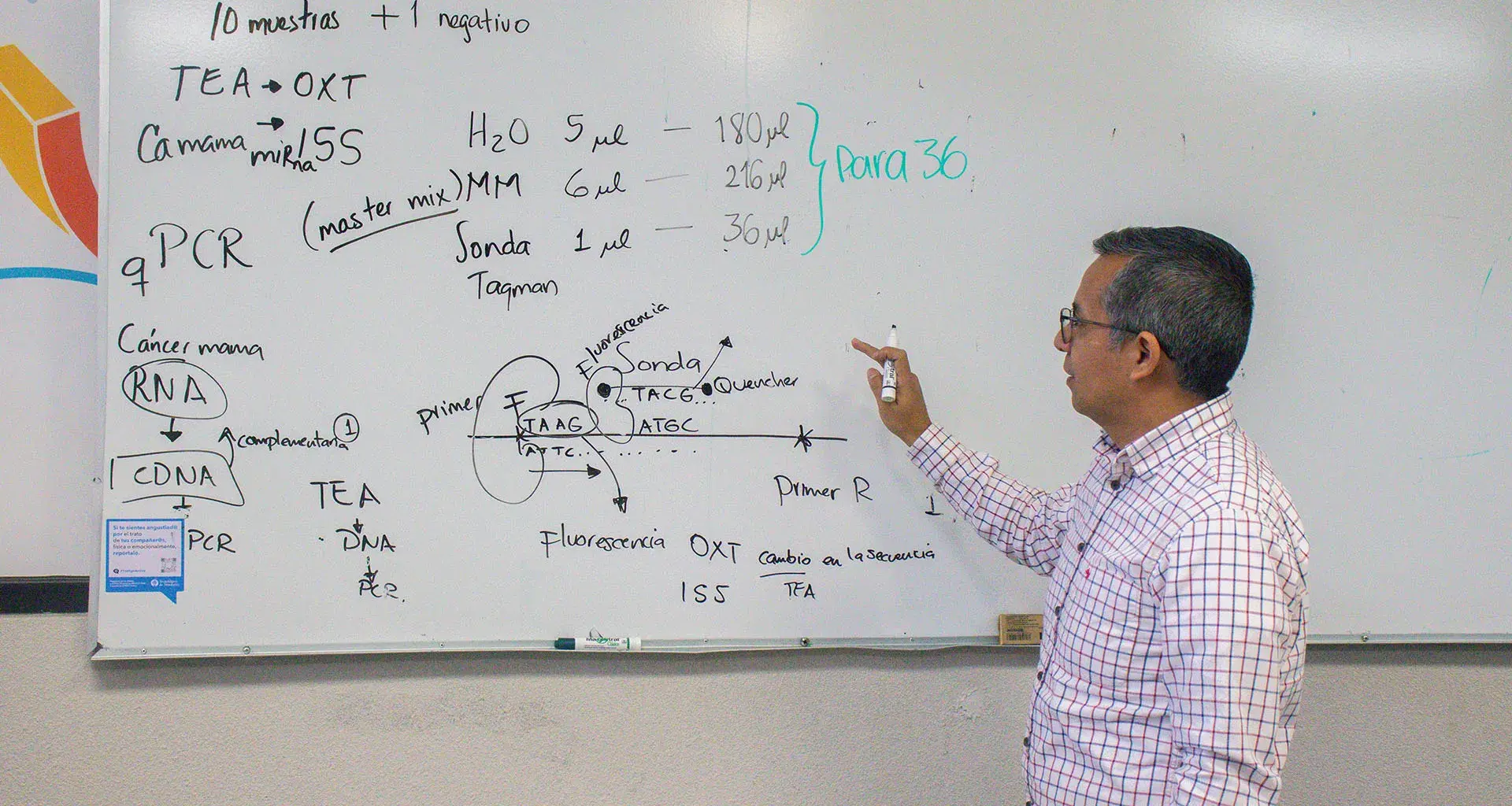

Faviel González was once evaluated by a Nobel Prize winner for co-authoring research that used programming to contribute to healthcare.
He has been evaluated by the winner of a Nobel Prize in Medicine, co-authored research that helped develop vaccines benefiting millions of people, and is now a professor at Tec de Monterrey’s Laguna campus.
Faviel González has more than two decades of experience, over the course of which he has contributed academic and scientific accomplishments, as well as accumulated international experiences and knowledge.
He currently teaches computing and data science with the aim of showing engineering students that programming goes beyond developing digital applications.
“My area is systems development. I worked in health sciences for over ten years, teaching doctors how to program and perform analysis.
“But now I feel much more qualified to teach those same concepts to people in engineering, where they’ll come in handy,” he said.
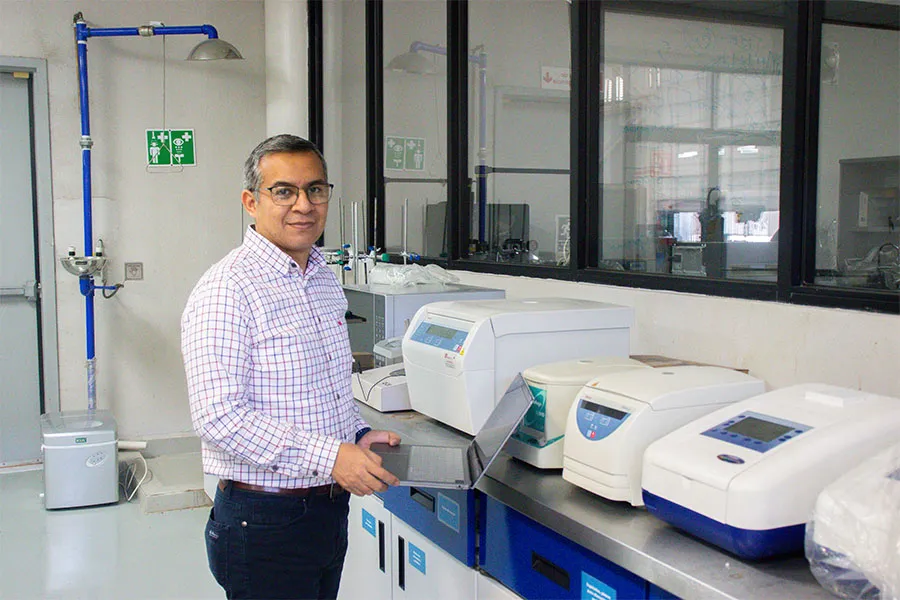
From mathematics to healthcare: Tec’s professor’s journey
The Tec professor recalls that he decided to study Computer Systems due to his curiosity about mathematics and developing applications for industry.
However, shortly thereafter, he was invited to develop for the area of health sciences. He said that this area fascinated him.
That’s why Faviel González decided in 2007 to go to the University of Liverpool, an institution renowned for its biomedical research and its scientists in the area of immunology and genetics.
Staying in the United Kingdom for six years, the professor studied for a PhD and worked on his thesis with an international research team.
There, he made one of his greatest achievements: developing a database on genes connected with the immune response, a tool now being used all over the world to make vaccines.
“I worked in health sciences for over ten years, teaching doctors how to program and perform analysis.”
“I never imagined that our database would be the most used one around the world today[...] to develop vaccines,” he said about his work in Liverpool.
Alongside that research, Faviel González took part in an international workshop held at University College London.
At the event, he was evaluated by health sector leaders, including the winner of the 2001 Nobel Prize in Medicine, Tim Hunt.
“Well, although it was a bit embarrassing as a computer systems engineer to be explaining something medical, it was a pleasure.
“It went well for me, really well... I tried to explain things that I knew he didn’t know. So, I used my methods to explain things in computational terms that he probably didn’t know,” he recalled.
From global research to classroom: Professor teaches more than code
Once he’d finished his PhD and postdoctoral stay, Faviel González returned to Torreón, where he became a professor at Tec de Monterrey’s Laguna campus.
For him, teaching doesn’t consist of simply passing on technical knowledge. In his classes, he tries to teach his students how programming can make an impact by applying it to real-world problems.
He mentioned that in an area such as medicine, it is crucial to understand information quickly and accurately, and he teaches how programming can achieve this.
“When you apply programming to biological data, you can identify genes that protect people or predispose them to certain illnesses. That changes how we think about medicine,” he explained.
“Programming changes how we think about medicine.”
Faviel González, who has devoted about 90% of his career to research and teaching, continues working on projects that can combine medicine with programming.
His goal is to focus on an area that develops and uses programs which analyze genetic information to discover connections that are invisible to the naked eye.
This type of work is part of what is known as translational medicine, an approach that seeks to take discoveries straight from the laboratory to benefit patients.
Research such as this has a double impact, from identifying groups at risk with greater accuracy to opening the doors to personalized medicine, which helps adapt treatments to everyone according to their genetic makeup.
Thanks to the opportunity afforded by being a teacher, the professor aims to help Torreón make a national and international contribution to science in order to strengthen and support hospitals and research centers.
YOU’LL ALSO WANT TO READ:
Seleccionar notas relacionadas automáticamente
1
Category:
Related stories