
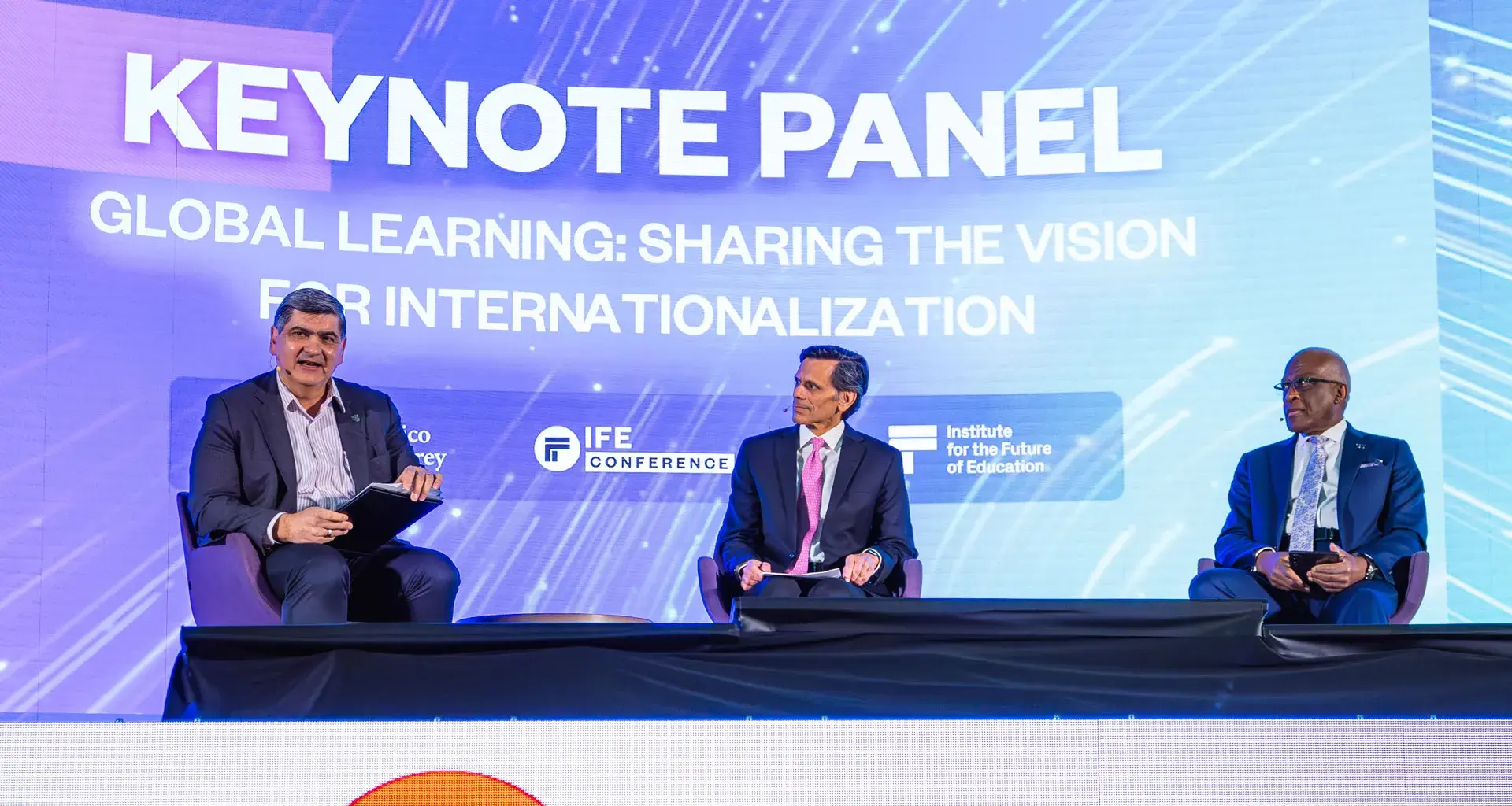

The presidents of two US universities analyze the challenges currently facing internationalization
Rectors and academic leaders have analyzed the challenges currently facing education at IFE Conference 2026.
One of these challenges is international collaboration to prepare students for the future, agreed US university leaders during the first day of IFE Conference 2026.
The keynote panel “Global Learning: Sharing the Vision for Internationalization” moderated by David Garza, President of the Tecnológico de Monterrey Education Group, featured academic leaders Michael Rao and Robert Jones.
Michael Rao, President of Virginia Commonwealth University, emphasized that internationalization makes attracting global talent a possibility, avoids duplicating efforts, and brings joint solutions to complex problems such as climate change.
“You have to understand that there is always someone smarter than you. Sometimes, they might be in your country, but more often than not, statistically speaking, they’re going to be someplace else,” he said.

He also warned that isolation is jeopardizing the United States’ educational leadership.
“People think that the United States is the best place ever for higher education, and that may be true, but it will not continue to be true if they isolate themselves and are not interconnected with the best minds throughout the world,”he said.
For his part, Robert Jones, President of the University of Washington, warned about the decline in student mobility and the impact this could have on innovation and academic development.
Jones said that the rise of the United States as an educational power has historically been linked to attracting international students.
“One of the reasons that the United States is the nation that it is today is because of the students we’ve been able to attract from all across the world,” Jones said.
David Garza asked about the importance of international collaboration and its impact on research in the wake of the pandemic.
“Research collaboration has truly evolved, including research conducted by universities in partnership with federal agencies in the United States,” Jones said.

Experience adds value to internationalization
The panelists agreed that internationalization should be accompanied by real professional experiences such as internships and applied projects to reduce the workforce skills gap.
Michael Rao said that for internationalization to add value to the workforce:
“We need to change higher education enough to ensure that students have professional experiences while they’re studying.
“They need to be in (paid) internships, perhaps in research environments, in discovery environments, opportunities that allow them to see why we’re teaching them what we’re teaching them, how it will be useful to them, and why it’s important,” he said.
Jones said that employers are now asking universities to make a major strategic effort to continue providing students with basic academic expertise.
“At the same time, we have to do a great job of preparing students for the workforce,” he explained.
“We need to be more intentional and more strategic in terms of preparing people, students, to be future-ready, and that is something that the US higher education system is starting to take more seriously,” he added.
Therefore, international collaboration based on trust and mutuality is required to reduce the workforce skills gap.
“If you can create a partnership based on trust and mutuality, where everyone brings something to the table, I think you’ve found the formula for discovery and for impact going forward,” Jones concluded.

Rethinking education in the face of AI
University leaders agreed on the need to rethink higher education in the face of the challenges posed by artificial intelligence (AI), during a panel moderated by Arturo Cherbowski, Director of Santander Universities and Director of Universia Mexico.
The panel The Decisions that will Define Universities Over the Next Decade was held on the first day of the IFE Conference 2026.
Ricardo Villanueva Lomelí, Undersecretary of Higher Education at the Ministry of Public Education (SEP), said via videocall that transformation must begin with the things which technology cannot easily replace.
He pointed out that the solution is pedagogical and that the evaluation of the future should be focused on critical thinking, grounded argumentation, reasoned decision-making, real case analysis, and ethical reflection.
“Single-word, closed, or standardized responses are highly automatable by artificial intelligence,” he stressed.
Similarly, Fernanda Llergo Bay, Rector of the Pan-American University and IPADE, as well as President of The Federation of Mexican Private Higher Education Institutions, called for placing criteria before technology.
“We’re reacting to what artificial intelligence does; perhaps what we’re lacking is the ability to think critically and act wisely in the face of this incredibly valuable tool, which is artificial intelligence, but the reality is that often we don’t think, we just react,” she said.
Llergo Bay said that teaching should be based on educational logic in which teachers and students are protagonists, and she encouraged strengthening teacher-student relationships, considering them the greatest wealth and primary competitive advantage for universities.
For his part, Luis Armando González Plasencia, Executive Secretary General of ANUIES, warned about the need for regulations that guide innovation with purpose.
“Innovation on its own can take an unexpected path, through an unforeseen world; it’s important to establish a regulatory framework that allows it to be guided and given a purpose,” he argued.
Finally, Bernardo González Aréchiga, Secretary General of FIMPES, said that the future of universities depends on them expanding their cognitive spaces.
“A fundamental challenge that today’s universities cannot escape is the integration of comprehensive cognitive spaces; I believe it’s a social and human responsibility that universities have today,” he concluded.
About the IFE Conference
This is the twelfth edition of the IFE Conference, organized by the Institute for the Future of Education at Tec de Monterrey, which is being held from January 27 to 29 on the Monterrey campus.
It is considered one of the most important educational innovation events in the Spanish-speaking world, featuring keynote speeches, panels, hybrid events, special events, awards ceremonies, presentations, networking opportunities, and more.
“The IFE Conference is a platform to energize people for the educational change required by Latin America, the Caribbean, and the rest of the world,” said José Escamilla, Associate Director of the IFE.
“It’s a space where the main stakeholders (in education) come together. This is the moment where we can make these connections and find out how we can work together to bring about this transformation,” he added.
This year, there are more than 4,300 in-person attendees and over 1,450 online participants from 46 countries, with more than 500 activities and 860 speakers.
ALSO READ:
Seleccionar notas relacionadas automáticamente
1
Category:
Related stories