
Tec executives shared five trends in lifelong learning that are reshaping the relationship between education, work, and personal development.
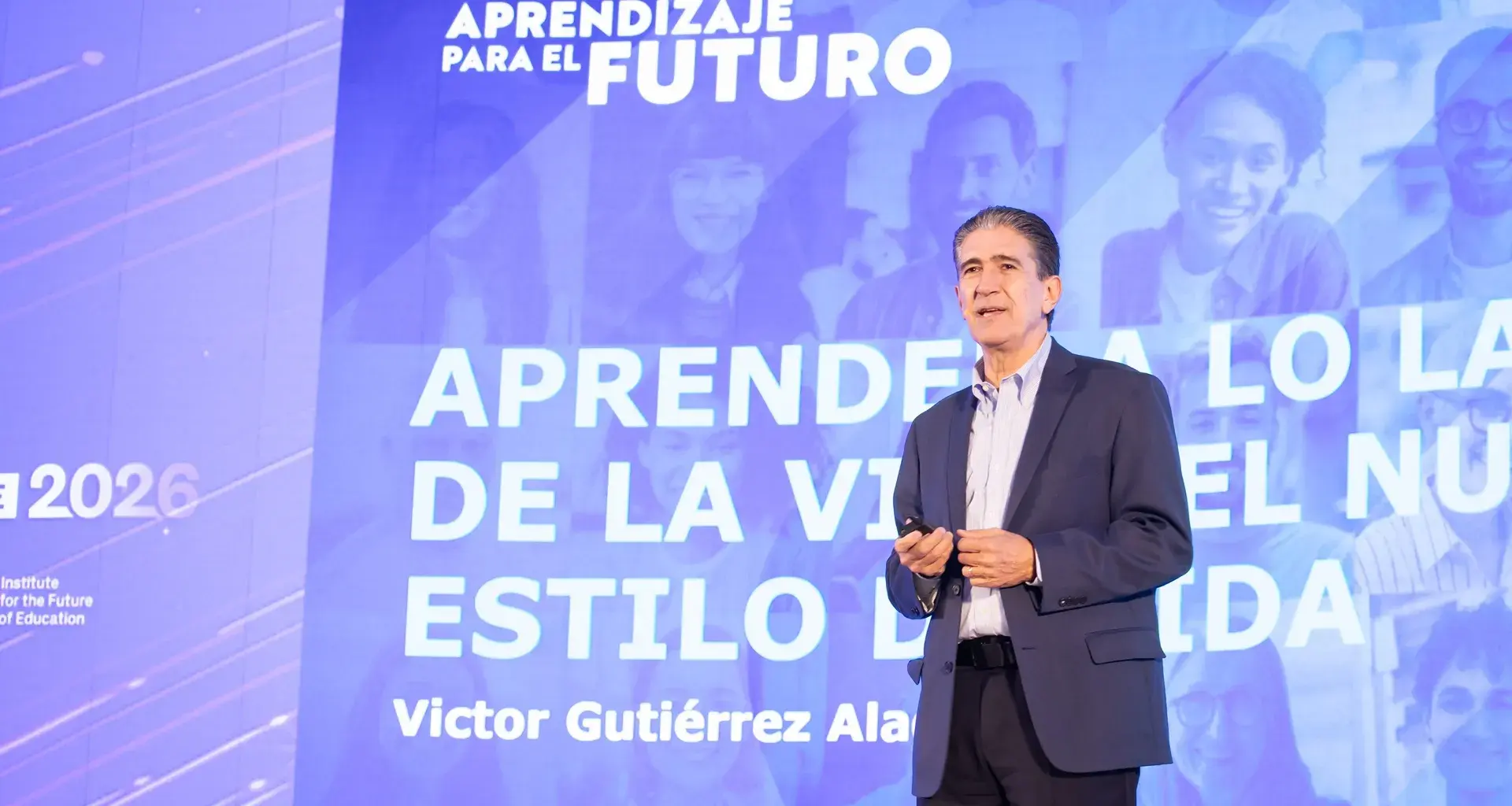
Learning is no longer a stage in life, but rather a lifelong process. That was the central idea propounded by Víctor Gutiérrez Aladro, Vice President of Lifelong Learning at the Tecnológico de Monterrey Education Group, when speaking at IFE Conference 2026.
“We never stop learning at any point in our lives”.
He emphasized that lifelong learning, far from being a fad, is a cross-cutting issue that now affects universities, businesses, and governments.
This being the case, he explained that the institution has rethought its approach to lifelong learning and set up the Lifelong Learning impact unit.
He explained that it is not just about acquiring new knowledge, but about adopting a mindset of continuous learning: “It involves developing the ability to constantly learn, unlearn, and relearn. The world changes and what we knew five years ago may no longer be relevant”.

Setting up the Lifelong Learning Impact Unit
Cintia Smith, Director of Foresight and Strategic Opportunities at Tec de Monterrey, warned that the traditional educational model no longer exists.
“That model consisting of twenty years of education, forty years of work, and then retirement no longer reflects the reality facing people as we come up to 2030”.
In response, the Tec de Monterrey Education Group created the Lifelong Learning impact unit in its path to 2030.
Gutiérrez Aladro said that the vision guiding this unit is “to inspire millions of people to learn throughout their lives” to transform and reinvent the way they impact the world.
“We deeply believe that education transforms lives and that people transform communities”.
The unit coordinates the efforts of the Tecnológico de Monterrey Education Group, Tecmilenio, TecSalud, and Tecnológico de Monterrey institutions in an ecosystem empowered by artificial intelligence that is focused on Latin America.
“It involves developing the ability to constantly learn, unlearn, and relearn”. - Victor Gutiérrez
Five trends that redefine learning
Professor Cintia Smith and Victor Gutiérrez Aladro outlined five major lifelong-learning trends that are already reshaping the relationship between education, work, and personal development.
1. We are living longer and better
People are not just reaching more advanced ages but are also remaining productive and mentally active. This demographic change requires a rethinking of education systems.
The challenge, Smith explained, not only involves resources or infrastructure, but also culture, by dismantling the idea that learning only belongs to the young.
2. Personalization of learning without sacrificing the social educational experience
“Artificial intelligence can be the greatest driver of inclusion in Latin America or the fastest amplifier of inequality”, warned Víctor Gutiérrez.
Smith emphasized that personalizing learning should not come at the expense of social aspects of teaching, which remains essential for developing critical thinking, collaboration, and human connections that enrich the educational experience.
3. Knowledge beyond content
In an environment where information is immediate, educational value shifts toward the development of judgment, ethical reasoning, creativity, and the ability to validate sources.
“Students need to learn not only what they should know, but how to think, how to learn, and how to apply knowledge in the real world”, Smith said.
4. Intergenerational learning communities
Younger learners bring digital fluency and fresh perspectives, while older generations contribute wisdom, context, and experience.
“It’s a model we have to create; it doesn’t exist today”, Smith said.
5. A university degree as a starting point, not an end in itself
According to data cited by Smith from the World Economic Forum, 40% of current skills will not be relevant by 2030. In this scenario, first degrees should prepare graduates to become recurrent university students throughout their lives.
The Tec professor recalled that “Plato used to say that true learning doesn’t end with childhood but is an ongoing process of discovery that accompanies us throughout our lives”.
“We have moved on from a one-stage education to having to become immersed in lifelong learning”.

Tec action points for lifelong learning
Victor Gutiérrez outlined Tec de Monterrey’s main initiatives for making lifelong learning a reality.
The first is a variety of flexible educational programs with personalized learning paths. The Tec currently offers more than 1,200 in-person, digital, and hybrid programs.
Additionally, Silver Economy programs targeting people over fifty-five have been developed.
Another key area is integrated support combining teaching, coaching, and mentoring.
The second initiative is education for social development with platforms driven in part by foundations and governments. Last year, almost 350,000 people enrolled in these programs.
The third initiative is a diverse team distributed throughout Mexico and Latin America.
Finally, the fourth initiative is the construction of a technological ecosystem and strategic alliances that will enable the impact to be scaled up.
“The challenge is to evolve at the same pace as the world”, concluded the Vice President of Lifelong Learning.
YOU’LL ALSO WANT TO READ:
Seleccionar notas relacionadas automáticamente
1
Category:
Related stories