
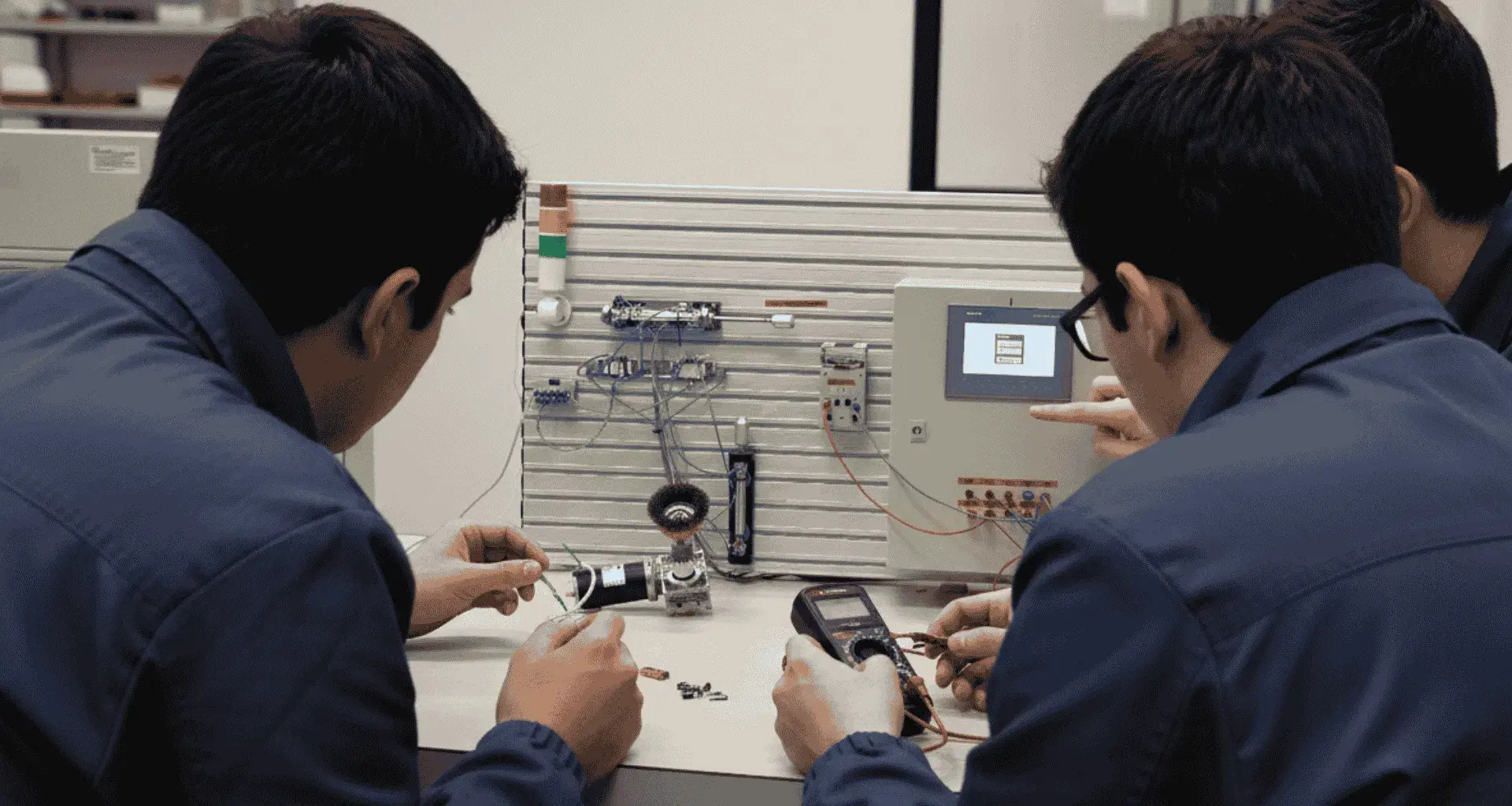

Mechatronics students from the Tec’s León campus have developed a hybrid laboratory connecting Mexico and Chile.
From October to November 2025, Mechatronics Engineering students from the Tec’s León campus participated in an international project focused on the development of a hybrid laboratory capable of being operated in person and remotely.
The project was developed in the fifth semester Industrial Automation course, and forms part of the Global Shared Learning Classroom initiative.
The work was carried out in conjunction with Universidad Mayor in Santiago de Chile, with the academic support of Dr. Thamara Villegas Berbesi.
On behalf of Tecnológico de Monterrey, the project was advised by Dr. Rosalino Rodríguez Calderón, a professor at the School of Engineering and Sciences on León campus.

A laboratory without borders
The challenge was to design a hybrid laboratory proposal that would allow technological resources to be shared between an automation company’s international locations.
The proposal integrated technology from Siemens in Mexico and Allen-Bradley in Chile, allowing students to remotely access and control equipment located in another country.
To test the viability of the laboratory, automation of a box transport line was undertaken using motors, pistons, and programmable logic controllers.
During the first stage, each team implemented automation using the technology available in their country. Afterwards, the system was used remotely from the opposing location.
"We learned a lot, not only about the course but also in terms of culture".- Luis Castro.
Academic and developmental impact
The project aimed to strengthen skills aligned with Industry 4.0, as well as reinforcing the multicultural collaborative work demanded by today’s industry.
This experience also aligned with Sustainable Development Goal 9, which focuses on innovation, sustainable industrialization, and the development of resilient infrastructure.
The project was developed by David Alcocer, Óscar de Jesús Andrade, David Cano, Luis Castro, Omar Gómez, Denisse Gómez, Alexa González, Noel Emiliano Hernández, Gabriel Jiménez, Jorge Martínez, Matías Montelongo, Miguel Rodríguez, and Luis Fernando Saucedo.
“The biggest challenge was being able to communicate and having the time to work on it, because many of us are employed,” explained Alexa González, a participant in the project.
"It was an opportunity to connect with another nation” .- Luis Castro.
Looking to the future
At the conclusion of the project, the students noted that the experience opened the door to further developing and scaling the hybrid laboratory proposal for more complex scenarios.
They also highlighted that the knowledge gained and the opportunity to operate equipment in other countries will be of great use to their professional development and future projects.
“It was a very satisfying experience; we learned a lot, not only about the course but also in terms of learning a little more about the culture there. I think it was a good opportunity to connect with another nation,” concluded Luis Castro, a student at the León campus.
YOU’LL ALSO WANT TO READ:
Seleccionar notas relacionadas automáticamente
1
Category:
Related stories