
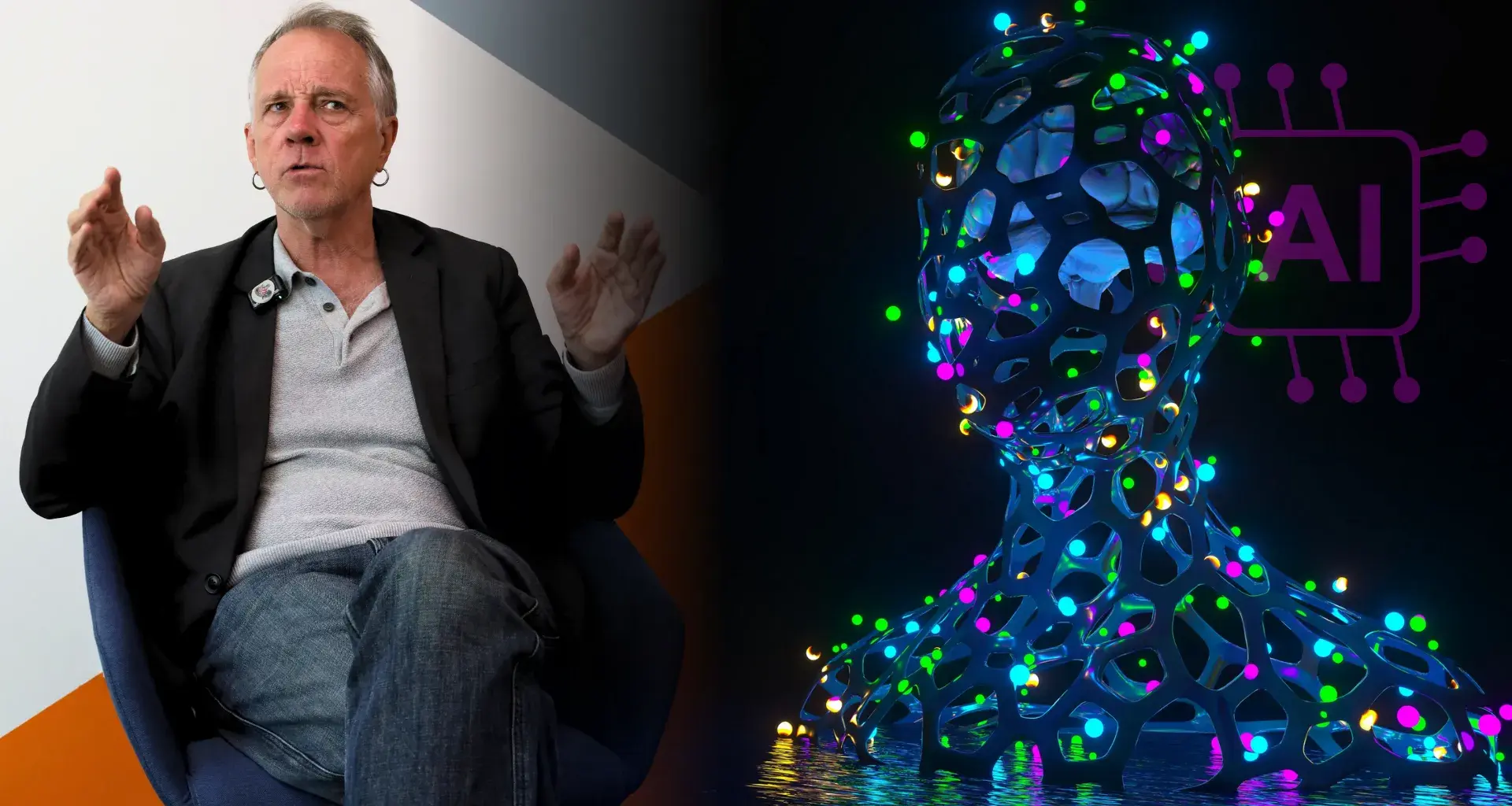

The cultural studies specialist and distinguished professor at the Tec challenges the discourse on AI and its consequences for society today and in the future.
As we live in a world increasingly driven by algorithms, Toby Miller, writer, researcher specializing in cultural studies, and distinguished professor at Tec de Monterrey, invited us to rethink artificial intelligence.
During his talk at the Mexico City campus, entitled “Death to AI, Long Live AI,” Miller addressed AI not only as a technological advance but also as an ethical, social, and environmental challenge.
Alejandra Arrieta, Director of the Communication program and moderator of the talk, pointed out the importance of discussing this technology in the current context.
“In the current political climate, it’s important to understand the role that culture and audiovisual media play in creating narratives. Toby Miller’s work invites us to reflect on these processes in the field of AI that are unique to students”, she said.

The media as stakeholders in change (and in the problem)
Miller focused on analyzing artificial intelligence with two basic interrelated elements: communication and culture. Within these elements, the key questions focus on power.
“To understand communication and culture, we must ask ourselves: who owns them, who controls them, and what meanings are constructed when we observe, play, or create?”, he said.
We must understand the interrelationship between these two concepts from this perspective, considering elements such as technology, policies, gender, workers, and audiences, but also the creation of meaning and social identity.
This should be based on the fundamental questions of who, what, when, where, how, and why.
However, Miller adds a question that serves as a starting point for any critical analysis: Who benefits? or Cui Bono, a Latin expression used to identify the beneficiary of a given situation.
“Toby Miller’s work invites us to reflect on these processes in the field of AI that are unique to students” .- Alejandra Arrieta.
The ecological cost of the digital age
A crucial point in his talk was about how the media not only serves as a means of explaining environmental science or climate change, but also as part of the environmental problem that is shaping our social identity.
He also highlights that the environmental impact of artificial intelligence is the most serious and potentially unsolvable problem, as it consumes enormous amounts of energy and water.
“One-third of the total water consumed in a year in a large country such as Turkey is used exclusively by Google to cool its data centers”, he said.

How AI influences global inequality
Although AI is often presented as a tool for improving efficiency, Miller warns that its actual impact could be much less than promised and has expressed concern about inequality and the impact it could have on people, as it exacerbates global inequality differences.
“The acquisition of generative technology has seen an investment of between $30 billion and $40 billion, with only 5 percent recording positive returns. Considering this technology is presented as fantastic and revolutionary, the figures are worrying”, Miller said.
Therefore, he proposes applying the “Precautionary Principle,” which states that, when faced with potential risks, it’s better to prevent than to wait for definitive proof.
This would encourage closer collaboration between Latin American countries, where the most influential nations in the region would have to negotiate together and demand clear commitments from the technological powers.
“We must get involved with artificial intelligence, improve it, and above all, protect people and other species on the planet from its environmental impact”, he concluded.
“We must get involved with artificial intelligence and protect people and other species on the planet from its environmental impact” .- Toby Miller.
About Toby Miller
Toby Miller has held positions at universities such as NYU and UC Riverside and is currently a member of the Faculty of Excellence, a Tecnológico de Monterrey initiative focused on attracting internationally renowned professors with outstanding experience to join the institution’s faculty.
Miller is also an author and editor of over 50 books. His most recent publications include Why Journalism? A Polemic; A Covid Charter, A Better World; Violence; and The Persistence of Violence: Colombian Popular Culture.
He was also the editor of the Journal of Sport & Social Issues and Television & New Media. Miller is currently the editor of Open Cultural Studies and co-editor of Social Identities: Journal of Race, Nation, and Culture.
ALSO READ:
Seleccionar notas relacionadas automáticamente
1
Category:
Related stories